Off doesn't mean quiet.
Smart TVs and projectors send data even when nobody is watching. Velmo sits between them and the world, and decides what leaves your home.
The three modes
Watch only
See every destination and when it first appeared. No blocking, isolation always on.
Protected
Stops telemetry, ads and content recognition. Streaming keeps working.
Aggressive
Only names that are explicitly allowed get out. Everything else is stopped at the first packet.
Devices from unknown brands start here.
A connected screen never stops talking
A smart TV is a computer on the internet, updated whenever its maker decides, talking to dozens of servers. Here is what it does while you watch, and while you don't.
Telemetry
It tells its maker and the apps how you use the screen: what you turn on, when and for how long.
Content recognition
ACR identifies what is on screen, even from an antenna or an HDMI input, and builds a profile of whoever is watching.
Targeted ads
Free channels and home screens carry tailored ads and audience-measurement systems.
Mapping your home
When it turns on it can sweep your home network and discover the other devices connected to it.
Shortcuts
It bypasses your home DNS and queries public or encrypted resolvers, so it can't be filtered.
While it's off
It stays connected when off: downloading, uploading and talking to servers while you sleep. Closed apps keep doing it too.
The bargain projector that resells your connection
Marketplaces are full of projectors, Android boxes and cameras at rock-bottom prices. Some leave the factory with software hidden in the firmware: on first connection it downloads instructions from a remote server and from then on, at regular intervals, asks whether there is more to do.
The most common job is turning your home into a residential proxy: someone on the other side of the world pays to route their traffic through your connection. If that traffic ends up in an investigation, the address that shows up is yours. And a factory reset won't remove it.
Velmo doesn't get inside the projector. It cuts off its route.
Isolated from your home, the projector can't reach your other devices. In aggressive mode it only gets out to what is allowed: the server giving orders never answers, and your connection isn't for sale.
The case was reported by DDay.it on 18 May 2026: Il lato oscuro dell'elettronica a basso costo su internet

How it works
Three steps. Your home router stays as it is.
Plug it into your router
A short cable between Velmo One and your router. Nothing else to change at home.
Move your screens onto its network
TVs and projectors join Velmo's wireless network. One Velmo covers every screen in the house.
You're already protected
Every screen starts protected, and an unknown device starts in aggressive mode. Then you decide, from the local interface.
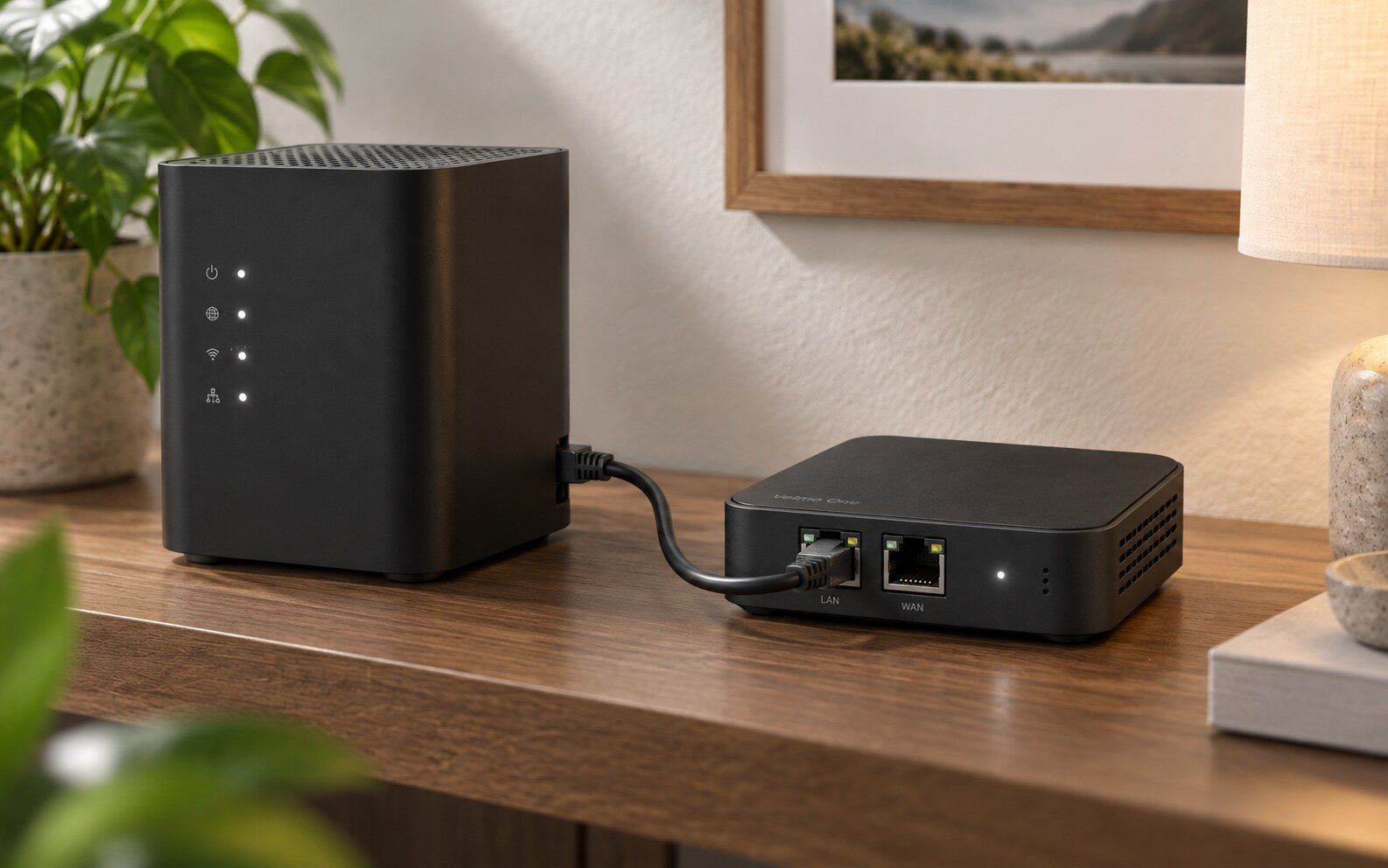
What Velmo One does
It isn't a filter with a list. It's a device built for screens: it knows who they talk to, when, and since when.
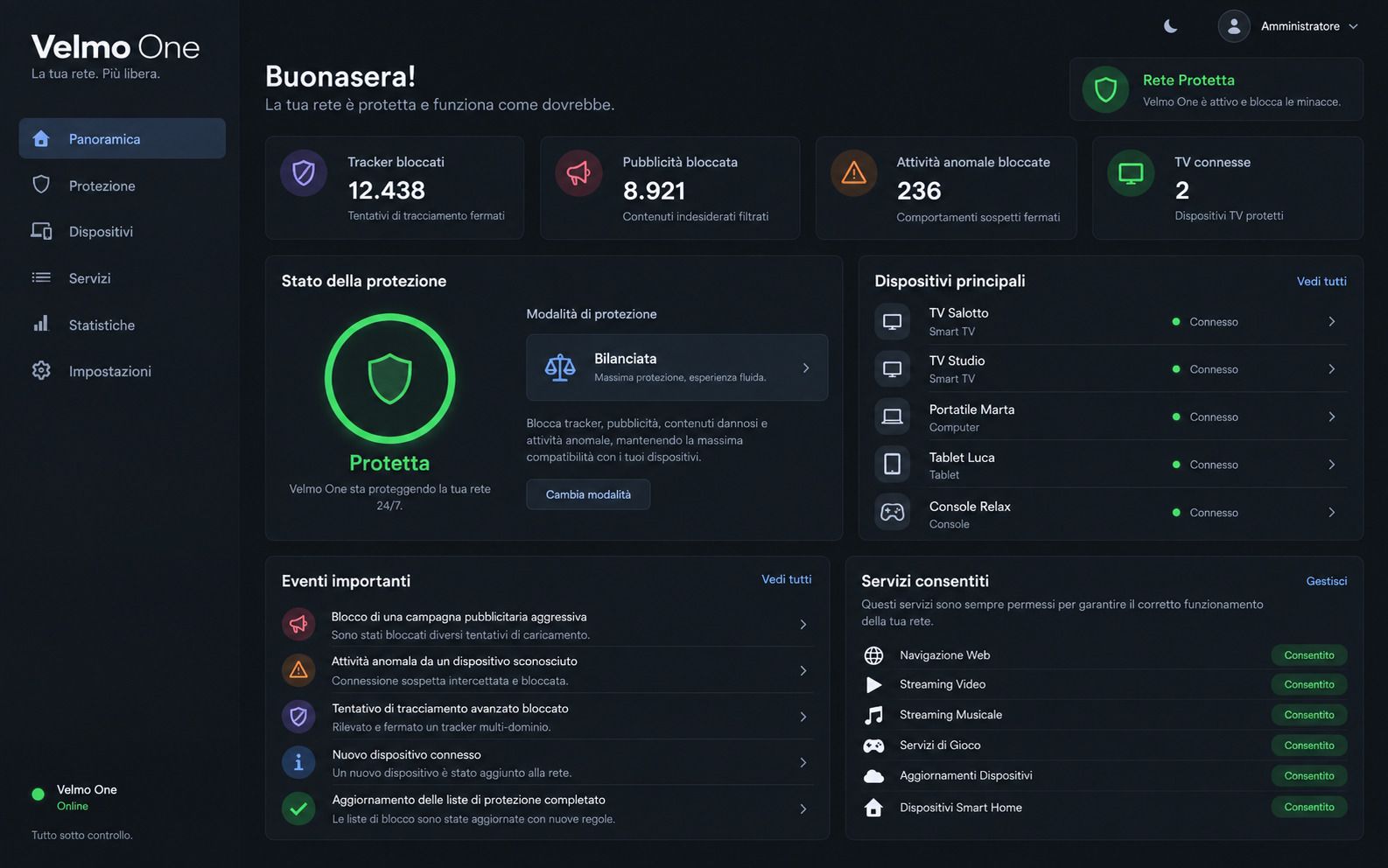
Isolates screens from your home
TVs and projectors can't see or reach the other devices in your home. Not even each other.
Closes the shortcuts
Every DNS request goes back to Velmo's resolver. Encrypted DNS and public resolvers stay closed.
Knows if the screen is on
It tells the traffic of a film apart from that of a screen you think is off.
Spots what's new
It notices a destination no list knows about, from the shape of its traffic.
Keeps up with changing names
One rule for a whole family of names, turned every minute into what actually goes through.
Remembers since when
For every destination you know when it first appeared, screen by screen.
Analyze
A guided walkthrough: what the screen does on its own, with apps, in the browser and when you change consent settings.
Shared profiles
Export a model's profile and share it with anyone. It carries the shape of the behavior, never your household's history.
Signed updates
Lists and rules arrive signed from velmo.one. Velmo downloads them, and your data stays home.
Pause button
Something not working? One press pauses blocking for a while, then it comes back on its own.
One for the whole house
A single Velmo runs every screen, each with its own mode and its own history.
You have the last word
Block or unblock any destination. The people who live there always win.
Why your router isn't enough
A router with a blacklist stops what someone has already catalogued. Putting your TV in the DMZ looks like protection, and it's the opposite.
| Topic | Router with DMZ and blacklist | Velmo |
|---|---|---|
| What it stops | Whatever someone has already put on a list | Also what no list knows about, from the shape of the traffic |
| Changing names | The list goes stale at the first firmware update | Families of names, rebuilt every minute from what goes through |
| Screen off | Doesn't know whether the screen is on | Knows what the screen did while it was off |
| History | Can't tell whether a name is new | When every destination first appeared, for every device |
| Bypassed DNS | Public resolvers and encrypted DNS slip past it | Every request goes back to Velmo's resolver; where DNS is silent, it reads the server name |
| Unknown device | Treated like everything else | Starts in aggressive mode: it only reaches what is allowed |
| DMZ | Exposes the screen to anyone coming from outside, and says nothing about what goes out | Isolates it from your home; every exception is declared, with who opened it and when |
| When a block breaks something | You switch off the whole filter | The people who live there decide, item by item |
Private by design
No account, no cloud
Velmo One is managed at home, from its local interface. There's no account to create and no server that knows who you are.
What it knows stays home
What Velmo learns about your screens stays on the device. Your history never leaves, not even to us.
It shares the shape, never the history
The profile you export describes how a screen model behaves. What you watched, and when, never goes into it.
It watches screens, not people
It observes TVs and projectors. Phones and computers stay on your home network, out of its sight.
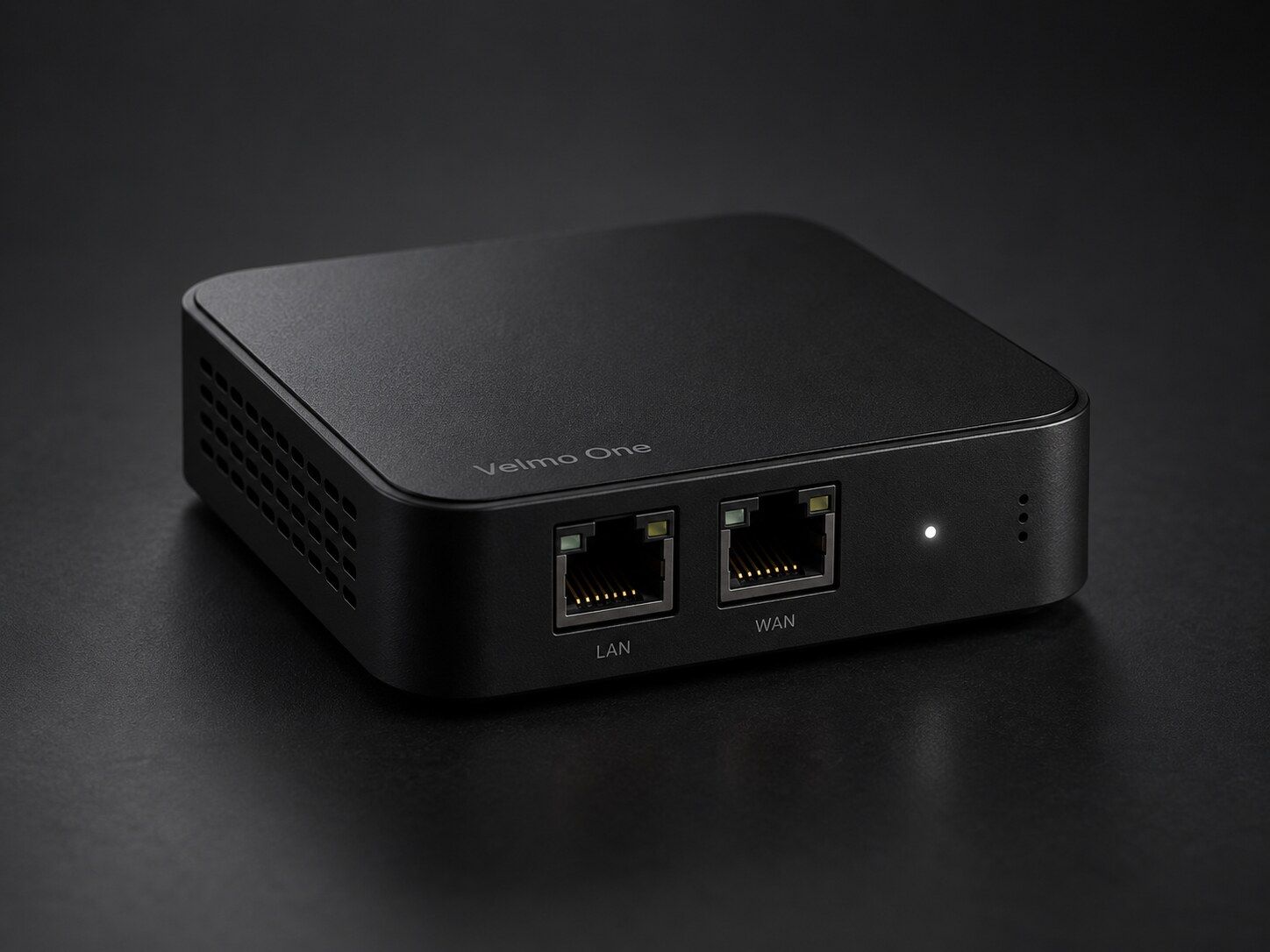
Velmo One is on its way
The prototype runs every day on real TVs, and we're preparing the crowdfunding campaign for the first batch. Want to know when it starts, try it early or work with us? Get in touch.
Contact usFrequently asked questions
Is my smart TV spying on me?
A smart TV collects data on how you use it: which apps you open, when, and often what is on screen, through automatic content recognition (ACR). It sends that data to its maker and their partners, sometimes even while it's off. Velmo One shows you who your TV talks to and stops what shouldn't leave your home.
How do I turn off ACR on a smart TV?
TV menus almost always have an option tied to "viewing information", but switching it off doesn't guarantee the transmissions stop. Velmo One works at the network level: in Protected mode it blocks content-recognition destinations, and in Aggressive mode only what is allowed gets out.
How can I block smart TV telemetry and ads?
A DNS filter stops names that are already known, but many TVs query public resolvers or encrypted DNS to get around it, and telemetry names change often. Velmo One sends every request back to its own resolver, closes encrypted DNS and spots new destinations from the shape of their traffic.
Can a cheap projector come with malware?
Yes. Projectors sold on marketplaces have been found with malicious software installed at the factory, which lends your home connection to strangers and survives a factory reset. Velmo One isolates the device from the rest of your home and, in Aggressive mode, only lets it reach allowed destinations.
Does putting my TV in the DMZ protect it?
No, it exposes it more. A DMZ opens a device to incoming traffic from the internet and does nothing to limit what it sends. A TV needs the opposite: isolation from your home and control over what goes out, which is what Velmo One does.
Isn't Pi-hole or a router blacklist enough?
They help with ads that are already known. They can't tell whether the screen is on or off, they don't recognise a destination no list contains, and they can't keep up with names that change every day. Velmo One is built for screens.
Will Netflix, YouTube and other apps still work?
In Protected mode streaming works: Velmo stops telemetry, ads and recognition, not films. In Aggressive mode only allowed services get through; if something doesn't work, pause blocking with one press or switch that screen to another mode.
Can Velmo see what I watch?
Not the content: connections are encrypted, and Velmo only sees their destination and shape. It knows which app the screen is using and when, because that's how it spots new behavior, and that history stays on the device: it never goes to us or anyone else.
Do I need an account or an app?
No. Velmo One is managed from its local interface, on your home network, with no account and no cloud. Lists and rules are updated from velmo.one through signed packages, without the device sending your data.
Does it work with every brand?
Yes. Velmo One works at the network level, so it protects any connected TV, projector or streaming box, whatever the brand. Its knowledge of individual models grows with updates and shared profiles.
When can I buy Velmo One?
Velmo One is in development and the crowdfunding campaign for the first batch is being prepared. Contact us to find out when it starts.
Take back control of your screens.
Tell us about your home or your business, and we'll tell you where Velmo One stands and how it can protect your screens.
Contact us